
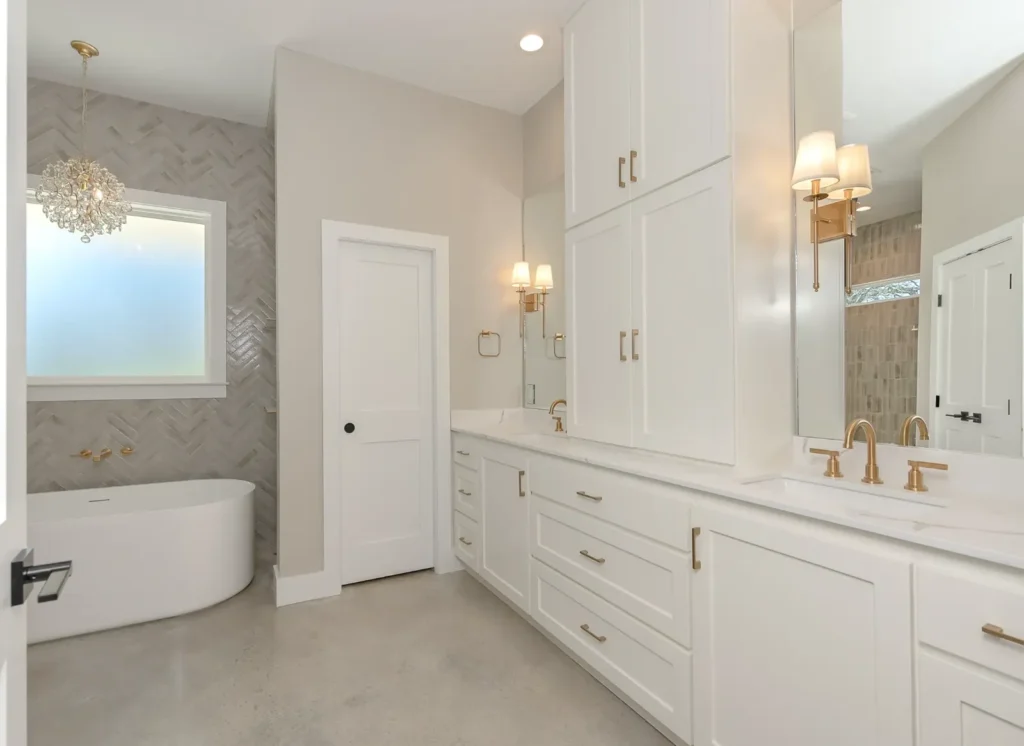
By Jason LaFollette, CEO, LaFollette Custom Homes
We kicked off this episode talking about selections Steve and I grew up with that should never, ever come back.
- Red shag carpet. It was about three inches tall. You couldn’t vacuum it. The only way to clean it was to mow it.
- Popcorn ceilings. With eight-foot ceilings and boys jumping around, half of it ended up in the shag carpet. Good luck getting it out.
- Polished brass everything. You could see yourself in it. It felt like we were all living on a cruise ship.
- Carpet around the toilet. Who thought that was a good idea? We refuse to do it.
Some things do come back, though. Wallpaper is back, and it’s not the wallpaper of the ’70s and ’80s. Our interior designer, Cindy, loves it. I fought her on it for a while, but I eventually saw the light.
Which brings us to today’s topic: selections, and how to keep them simple instead of overwhelming.
Why Custom Home Selections Feel So Overwhelming
- The number of decisions. Most first-time builders know they’ll pick flooring, countertops, cabinets and a color palette. What they don’t expect is the hundreds of small decisions that go with those big ones.
- It’s unfamiliar. Builders and designers make these decisions every day. Most clients have never done it.
- The pressure. You’re paying for it, and you have to live with it. (I’m still thinking about that pink tile in our first house.) Nobody wants to be wrong.
All of that adds up to decision fatigue. If you try to make too many decisions at once, you’ll wear yourself out.
The Biggest Mistakes
- Thinking you have to make every decision at once. If a builder or designer says, “We’re making all your selections today,” you might need to run away. Don’t look back.
- Second-guessing. Everybody does it, whether it’s picking out a countertop or fishing tackle. Just know it’s coming and try not to give in.
- Fear of missing out. Shopping for ideas is good. But if you lock in on what you want before your plan and your vision are set, those ideas can get in the way later.
The fix: start with the big picture, then work your way into the details. As Steve put it, you don’t have to make all the decisions at one time. You just have to make the next one.
Can You Have Too Much Inspiration?
Not really. Steve asks every new client for inspiration photos, and most bring 10, 20, sometimes 50 or more. (He recently had someone show up with zero. A blank canvas can be good too.)
The trick is finding the common thread. A client might bring a photo of a kitchen, a living room and a bathroom. Each one looks amazing, but side by side they don’t flow together. So we ask: What do you like about this picture? The floor? The cabinets? The colors? The natural light? The warmth?
Inspiration is great. But it has to turn into direction.
Start With the Big Picture
Outside: Brick, stone, siding or a mix? A metal roof or shingles, and what color?
Inside: Raised ceilings? What style of cabinets? What color palette? Then countertops and flooring.
Then the details: light fixtures, plumbing fixtures, and that little cabinet knob that seems so small but still has to fit the big picture.
If you don’t set a clear vision early, everything becomes an option. And when everything is an option, that’s when it gets overwhelming.
My Confession
For the first 14 years of my career, I was a one-man show, and I was definitely not an interior designer. I’d set up my clients’ allowances, hand them a list of vendors, and send them out the door. Good luck.
I was doing the best I could, but I had no idea how stressful that was for them. To those clients: I’m sorry.
Now we have an interior designer who goes with our clients and helps them through each decision. She can tell when someone has that glazed-over look. That’s when it’s time to break for lunch, or say, “Let’s meet again tomorrow with fresh minds.”
A Good Designer Narrows Your Choices
A good interior designer doesn’t give you more options. She gives you fewer. Because she already knows what you like, she’ll show you five doorknobs, not 200. And if none of those five work, she has five more ready.
She also knows your budget and your lifestyle. If your kitchen island is where the kids eat, do homework and hang out, put more money there and save somewhere else. Steve said it best: spend your money where you spend your time.
(And for the record, the man cave stays.)
QUICK NUMBER · INDUSTRY DATA
Interior finishes were the biggest single piece of construction cost in NAHB’s 2024 national survey, at 24.1%. Your selections really do move the budget. (NAHB)
Death by a Thousand Cuts
Keeping your selections on budget starts way back in plan design. Here’s how:
- Get your interior designer involved during plan design, not after.
- Set realistic allowances up front.
- Know the cost impact as you go, not at the end.
- Separate your must-haves and your nice-to-haves.
Steve calls going a little over on every selection “death by a thousand cuts.” $100 over here. $400 over there. $600 somewhere else. It doesn’t sound like much, but it adds up fast. And something like appliances can jump thousands if you decide you want top of the line.
A good designer will say, “That’s beautiful, but it’s $400 more. I know one that looks almost exactly like it that keeps you on budget.”
QUICK NUMBER · IN THE EPISODE
$100 here, $400 there, $600 somewhere else. That’s how small overages turn into a big one.
Stop Second-Guessing
When I asked Steve what he’d tell a client who keeps second-guessing, his first answer was, “Stop doing that.”
His real advice: trust the process. There will always be another beautiful countertop and another beautiful doorknob. Once you’ve picked one with your designer, don’t go home and keep shopping. Your designer knows every selection you’ve made so far and how they fit together. Go with your gut and move on to the next one.
But stay open-minded, too. A good designer will stretch you a little. Years ago, we had someone help us repaint our kids’ bedrooms. She told us to paint the ceilings the same color as the walls, just in flat. I dug my heels in. Everybody knows ceilings are supposed to be white! But I figured the worst case was repainting, so we tried it. My wife and I loved it.
Just remember: it’s your home and your vision. A designer should stretch you, not push her own style on you.
The Goal Isn’t Perfection
Every decision is connected. Flooring affects cabinets. Cabinets affect countertops. Countertops affect the backsplash. The goal isn’t for one selection to stand out. It’s for the whole house to stand out.
Here’s the recap:
- Start with a clear vision.
- Trust the process and listen to your interior designer.
- Stick to the selection schedule.
- Know where your budget stands as you go.
- Don’t second-guess yourself.
- Don’t chase perfection. Chase good design you’ll love living with every day.
This is your chance to pull together everything you’ve been carrying around for years, maybe even something that was in grandma’s house that means a lot to you. It should be one of the most enjoyable parts of the whole build.
Fun Facts
- In the episode: The red shag carpet we grew up with was so tall the only way to clean it was to mow it.
- In the episode: One of us (we won’t say who) has an avocado green refrigerator in the garage that’s about 50 years old and still running.
- Industry data: NAHB’s study of how long home components last puts a standard refrigerator at about 13 years. That 50-year-old fridge is almost four lifetimes in. (NAHB life expectancy study, 2007)
- Industry data: The same study puts carpet at about 8 to 10 years with normal use. We’re guessing the shag outlived that. (NAHB)
- Industry data: Older popcorn ceilings can contain asbestos. The EPA says not to scrape, sand or drill anything you think might have asbestos in it. Call a pro to test it. (Sorry, Mom.) (EPA; background)
Next episode: communication, and why it makes everything in a build run smoother.
Watch or listen to Episode 8
Come hear Steve explain how “death by a thousand cuts” got its start.
Thinking about building in the Brazos Valley? I’d love to talk. Reach out to our team or call (979) 589-8343.
Sources
- NAHB, “Cost of Constructing a Home in 2024” (Jan. 2025): https://www.nahb.org/news-and-economics/housing-economics-plus/special-studies/special-studies-pages/cost-of-constructing-a-home-in-2024
- NAHB / Bank of America, “Study of Life Expectancy of Home Components” (Feb. 2007): https://www.reservedataanalyst.com/mt-content/uploads/2019/10/national-association-of-home-builders-life-expectancies.pdf
- U.S. EPA, asbestos exposure guidance for families: https://www.epa.gov/asbestos/protect-your-family-exposures-asbestos
- Wikipedia, “Popcorn ceiling” (background only): https://en.wikipedia.org/wiki/Popcorn_ceiling